The Portuguese they actually speak in Portugal.
Not Brazilian. Not a phrasebook. A real course from your first bom dia to the citizenship exam — with a login and a level for everyone in the house.
€13/month for one · €25/month for up to 4 · VAT included
- Card not charged for 7 days
- Cancel in two clicks
- 21-day refund after that
- Secure payment via Stripe
Or find out where you stand. Six questions, no account, about a minute.
Dealing the questions…
Every other app teaches the wrong country.
This is a perfectly good Portuguese sentence. It is also the sentence a year of the popular apps will teach you to say — and in Lisbon it lands like an American accent doing Cockney.
Peguei o ônibus depois do café da manhã e agora estou falando com você no celular. O banheiro fica ali.Six words, six tells. Here you learn the other column — and why the sentence above marks you as having learned somewhere else.
| In English | What the big apps teach | What is said in Portugal |
|---|---|---|
| bus | o ônibus | o autocarro |
| breakfast | o café da manhã | o pequeno-almoço |
| mobile phone | o celular | o telemóvel |
| bathroom | o banheiro | a casa de banho |
| I am speaking | estou falando | estou a falar |
| with you | com você | contigo |
Scroll the table sideways for the other columns.
A promise you can check.
Any app can say European Portuguese on the homepage. These are the three things that make it true here, and all three are build steps rather than intentions.
A Brazilianism linter on every lesson
Ônibus, banheiro, celular, trem, café da manhã, você-as-default and the gerund are checked mechanically before a line reaches you. When something slips through, it is a bug with a fix — not a matter of taste.
A style contract in every prompt
Tu with real pt-PT endings. Estar a + infinitive, never the gerund. Clitics on the right side. It is attached to every single generation, not just the ones about grammar.
European voices, at real speed
Dialogues, dictation and stories are voiced with European Portuguese neural voices, unslowed. It is the Portuguese your ear will actually meet at a counter.
163 units, in an order that holds.
135 units
From greeting a neighbour to arguing with a landlord. Each unit says what you will be able to do at the end of it — and where you are in the level.
16 units
The CIPLE A2 exam the nationality application asks for — its four task types, timed, in the reading and listening shapes it actually uses.
12 units
History, geography, the Constitution, the national symbols — the country knowledge the citizenship process expects you to have.
The exam is usually somebody else’s course. Dedicated CIPLE preparation exists, and it is a second thing you buy — one that starts at the point where your Portuguese is already A2. Here the road to the exam, the exam drills and the civics behind them are the same subscription as your first bom dia. If nationality is why you are here, that is the reason to choose this one.
It bends to you, not the other way round.
Every other European Portuguese course is a fixed set of recordings — very good ones, and the same for everybody who buys them. This one is generated, which is the whole reason it can do the next three things.
A plan, not a placement score
The test at the start does not just hand you a level. It says what you missed, names the gaps it found, and builds a short plan out of them — with a line on every step saying why that step, now.
The course reorders itself
Say you want to speak and the speaking comes first. Say you are shy and it puts the games and the writing ahead of the microphone. Same 163 units, dealt in the order that suits the person.
Learn the Portuguese you actually need
Type any topic and get a lesson, a quiz, a game, a dialogue, a story or a conversation about it — your parish and the words used at mass, the vocabulary of your trade, sailing, football, the paperwork at Finanças. Not a preset category: whatever you typed.
Why that matters: a recorded course can only ever teach what somebody thought to record. If your Portuguese has to work at a church committee, a building site or a boatyard, the words you need were never on the list — and no amount of finishing the course puts them there.
What the first week actually looks like.
No setup call, no shipping, nothing to install. You are in a lesson about ten minutes after you decide to be.
Twenty minutes, once
Everyone in the house takes the real placement test — it adapts, stops when it knows, and ends with a level, the gaps it found and a plan built out of them.
Three lessons in
Sandra has marked your first homework answer by answer, and the words you got wrong are already scheduled to come back as review.
Day seven
You have done a real errand in Portuguese, the household board has a leader, and the card has still not been charged. Decide then.
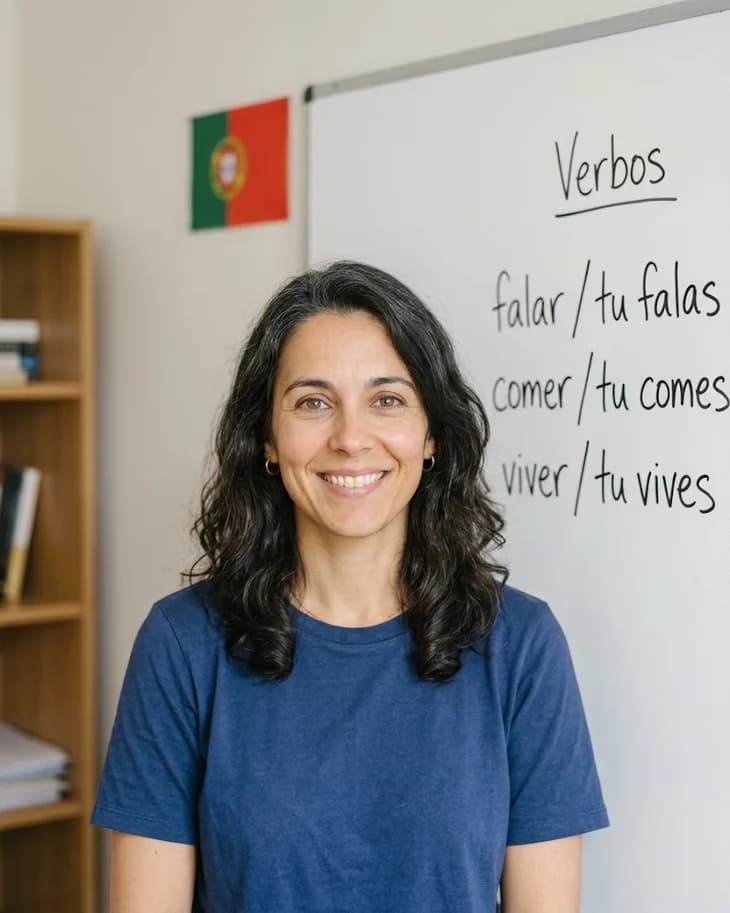
Meet Sandra.
She explains in English, corrects in European Portuguese, and tells you what you actually got wrong rather than giving you a score.
A course, not a streak.
Everything below is included in both plans. There is no tier that withholds the useful half.
Review that finds you
Mistakes from homework, quizzes and games become flashcards that come back just before you would have forgotten them.
Listening and dictation
Two-voice dialogues with tap-to-replay transcripts, plus hands-free sessions for the car.
Stories where you live
Serialised chapters at your level — the beach, the mercado, the neighbours — with audio and questions.
Six two-minute games
Gender, word order, verb forms, odd-one-out. On any topic you type in, including the one you just got wrong.
Real errands
Missions you rehearse at the kitchen table and then go and do. Portuguese sticks out there, not in here.
Homework, marked
Set by Sandra and corrected answer by answer, with specific feedback rather than a score.
Pronunciation scored
Read a line aloud and hear where it went wrong — the sounds English speakers actually miss in pt-PT.
One subscription. Everyone at their own level.
A nine-year-old and a parent are not doing the same course. Everyone is placed separately, progresses separately, and shows up on the same board.
A login each
Own account, own level, own next lesson. Nobody is dragged through somebody else's unit.
Placed, not guessed
A short test at the start puts each person where they actually are — including the beginner who should simply start at A1.
Something to beat
A weekly household board. It turns out the fastest way to get a child to practise is a sibling who already has.
What you are actually choosing between.
There are three kinds of answer to “I want to learn Portuguese, properly, in Portugal”. This is where each of them is strong and where it stops.
Every row is something you can verify before you pay us anything.
| PoisPois | Recorded pt-PT courses | The big streak apps | |
|---|---|---|---|
| Which Portuguese | European, linted line by line | European | Brazilian, in almost every case |
| Adapts to you | Placement builds a plan; the course reorders itself | The same recordings, in the same order, for everyone | One fixed tree with a streak on it |
| A lesson on a topic you type | Any topic at all — twelve generators | Only what was recorded | No |
| A2 (CIPLE) exam track | 16 units, timed, the four real task types | Usually a separate course, bought separately | No |
| Civics for the nationality file | 12 units | Rarely | No |
| The whole household | Up to 4 logins, each at their own level | One price per learner | One price per learner |
| Work marked, not scored | Sandra corrects answer by answer | A forum, or a teacher you book | A percentage and a cartoon |
| Price | €13 for one · €25 for four | About €15 a month, one person | Per learner, with a free tier |
Scroll the table sideways for the other columns.
The recorded courses have a decade of material and a following they earned, and if you want a library of episodes to work through they are excellent. What they cannot do is be about your trade, your parish or your landlord — and they do not take the household with them.
Seven days free. Then this.
Individual
One person, everything included — Sandra, the full course, the games and the review.
Family
UP TO 4 PEOPLEThe whole house on one account, each person on their own course at their own level. Just over six euros each — and €7 a month per extra person beyond four.
VAT included — what you see is what you pay. Pay yearly and you pay for eleven months instead of twelve. You can also pay in dollars.
For context: the best-known European Portuguese course charges €15 a month for one person. Family is €25 for four, and it is the only one of them that carries you all the way to the nationality exam.
How the free trial works
We ask for the card up front and charge nothing for seven days. Cancel before the end and you pay nothing — not a refund, a charge that never happens. After that, you have 21 days from the charge to ask for your money back.
The questions people actually ask.
I already learned some Brazilian Portuguese. Is this a waste?
How is this different from the European Portuguese courses people already recommend?
Is this enough for the nationality application?
Do I need an app, or does it work on my phone?
Will my children actually use it?
Can it teach my specific thing — my job, my church, my hobby?
What if we stop?
Do you use AI, and does that mean the Portuguese is unreliable?
Pois pois — the sound of being understood.
It is what someone says while you are still talking. Right, right, go on. You will hear it long before you can explain it, and one day you will say it back without thinking.
Start free for 7 days